Hebrew Mysteries
Week 32
Psalm 32:1
Marlene Bredenkamp • 27 November 2026

Recap Hebrew
- There are 22 letters in the Hebrew alphabet.
- Hebrew is a alpha numerical language
- Each letter has a pictograph
- ELS reveals hidden mysteries
- The effect of revers numbers (inverses)
- Root words
- Sofit letters
- Nouns
- Verbs
- Directions
- Triple numbers
- Future tense
- Letter kaf ךכ Sofit kaf
- Double numbers
- The letter yod
- Number of appearances
- The definite article
- Equations
- Hebrew calendar
- Antonyms
- Synonyms
- Diacritical marks - dagesh (kal)
- Gender
- Acrostic passages
- Repeated texts
- Old Testament Types
- Sha’atnezgets letters
- Legal concepts
- Doxologies
- The letter shin
- Theophanies
- Covenants
- Chiasmus
- Concrete v Abstract
- Superscriptions Part 1, Miktam
- Superscriptions Part 2, Shiggaion
- Superscriptions Part 3, Shiyr
Additional:
- Superscriptions Part 4, Maskil
- Verbs - Past Tense
Superscriptions (epigraphs) in the Psalms Recap
Various Psalms make use of superscriptions. There are the different
superscriptions mentioned in the Psalms:
- Miktam: Psalms 16, 56-60;
- Shiggaion: Psalm 7;
- Shiyr: 46, 48, 66, 83, 88, 108, 120-134,145;
- Maskil: 32, 42, 44-45, 52-55, 74, 78, 89,142.
- Tefillah: 17, 86, 90,102;
- Mizmor: 3-6, 8-9, 12-13, 15, 18-24, 29-31, 38-41, 47,49-51, 62-68, 73, • 75-77, 79-82,84-85, 87, 92, 98, 101, 109-110, 139-141, 143.
Scripture Reference
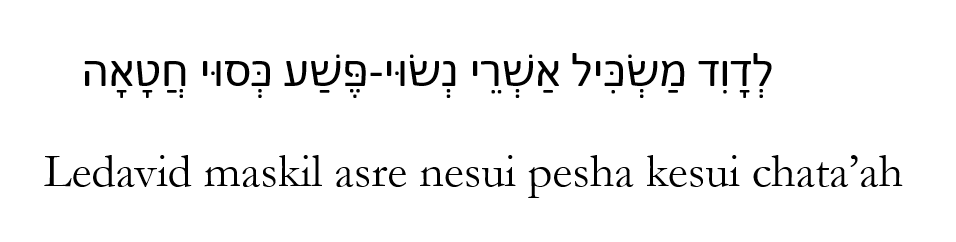
Psalm 32:1 A MASKIL OF DAVID. Blessed is the one whose transgression is forgiven, whose sin is covered.
Psalm 32:1 in Hebrew
What is a maskil
The word “maskil” comes from a Hebrew root associated with understanding, prudence, wisdom and acting with insight.
The root word, שכל sakal, means “to act wisely”.
A maskil is a didactic poem and intended for teaching.
Psalm 32 teaches that honest confession leads to forgiveness and renewed fellowship with God. Hidden sin however, leads to misery.
Pictographs of maskil
מַ — picture of water, representing people;
ש — picture of teeth;
ְכִּ — picture of palm of the hand;
י — picture of arm;
ל — picture of staff.
Man מ lead ל by the arm י and hand כ of the Lord is delivered from the evil of this world ש.
“I am the LORD, and I will redeem you with an outstretched arm and with mighty acts of judgment,” Exodus 6:6.
Verbs in Hebrew
A verb is used to describe an action or a state of being.
Each Hebrew verb is based on a three-consonant root, called shoresh.
The kind of action is expressed by in a particular structure called a binyan.
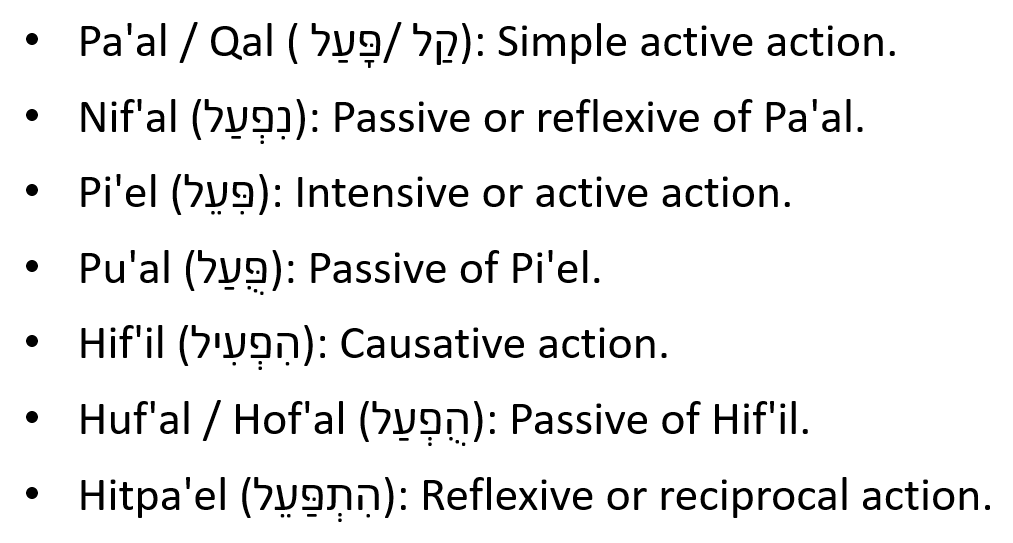
There are seven binyanim in the Hebrew language. Each binyan has a present, past and future tense.
The Qal (קַל) stem is the most basic and foundational verbal stem, binyan, in Biblical Hebrew. The perfect conjugation, also called Qatal, indicates a completed action.
Binyanim
Past Tense Qal
Psalm 32:5 reads: I said, “I will confess my transgressions to the Lord,” and You forgave the iniquity of my sin.

Amarti owdeh ale fesay leYahweh
The Hebrew root word for “say” is אמר amar.
The Hebrew perfected action verb is in the Qal perfect tense.
In the text, the word “said”, is in the first person singular Qal perfect tense.
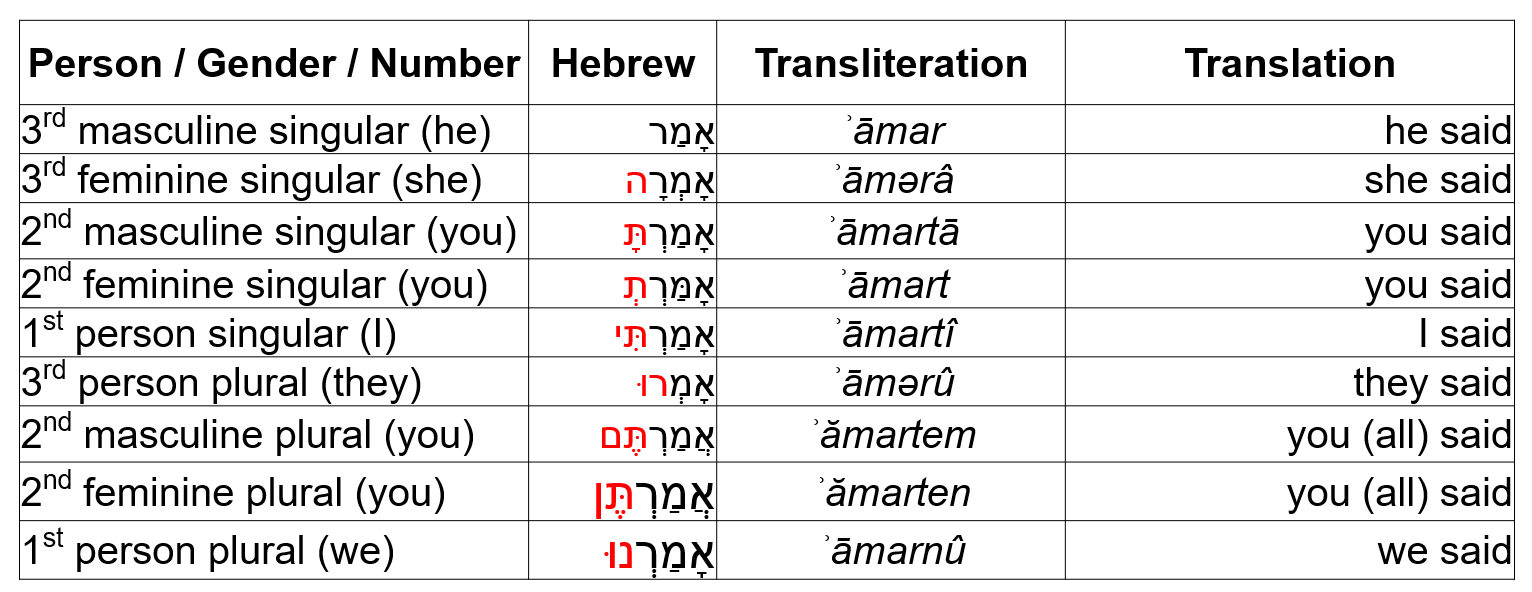
To form the past tense of 1st person masculine singular, a suffix of the letters tav and yod is added. אמרתי — amarti
Binyan ר-מ-א amar, Qal perfect
suffixes in
red
The importance of the past tense
In Psalm 32, David illustrated the consequences of a completed action:
Verse 5 reads: “I acknowledged my sin to You, and I did not cover my iniquity; I said ‘I will confess my transgressions to the Lord,’ and You forgave the iniquity of my sin.”
Completed action: Confession, result: forgiveness.
Verse 3 reads: “For when I kept silent, my bones wasted away through my groaning all day long”.
Completed action: Keeping silent, result: misery.
What has been done in the past, in terms of confession of sin, determines the future.
Jesus in Psalm 32
Jesus is directly addressed or referred to as "Teacher" or "Rabbi" dozens of times by His disciples, the crowds, and even religious leaders like Nicodemus.
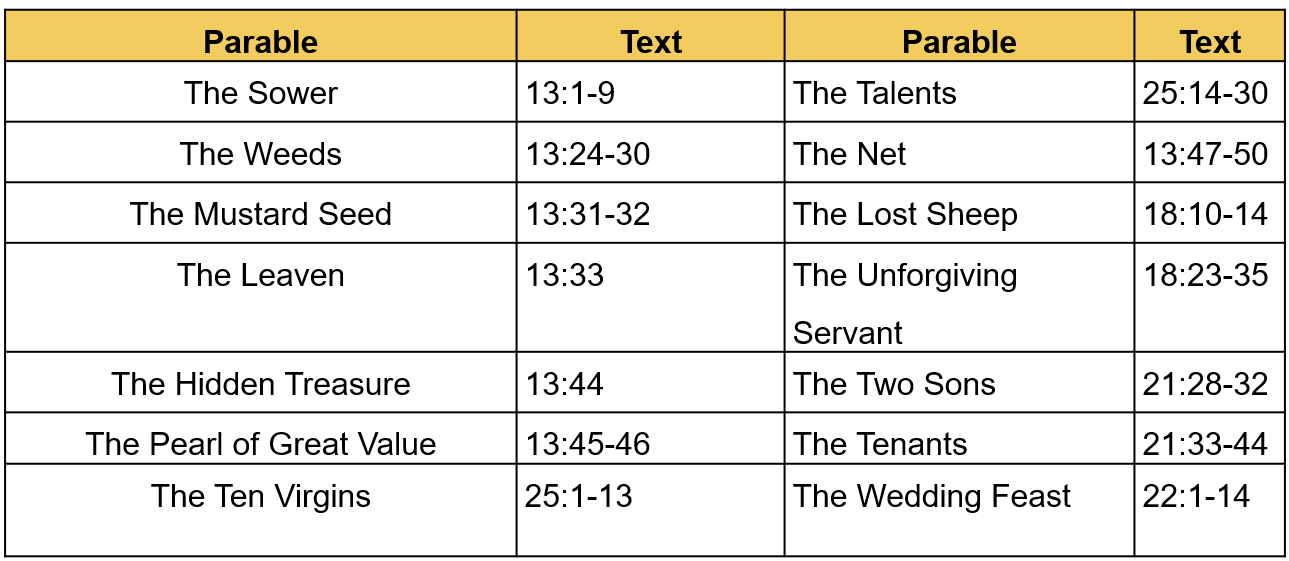
Jesus taught in parables: Take My yoke upon you, and learn from Me, for I am gentle and lowly in heart, and you will find rest for your souls. Matthew 11:29.
Parables in Matthew
The number 58
The ordinal value of the Hebrew word maskil, is 58.
The Hebrew word יהושע Yehoshua, Jesus, has an ordinal value of 58.
10 + 5 + 6 + 21 + 16.
The word Yeshuaיֵשׁוּע —is a later, shortened Hebrew and Aramaic form of Yehoshua which means "salvation".
The sum of numbers 5 + 8, is 13. Jesus was the 13th man.
Jesus acknowledged the title Teacher, "You call me Teacher and Lord, and you are right, for so I am“, John 13:13–15.
Conclusion
A maskil is a teaching that instils truths. Maskills teach to us to place our hope in God and trust in the Lord and in His Son, our Saviour and Lord. He is
The Way, the Life and the Truth.
John 14:6.
Prayer
May the Lord give you a spirit of wisdom and revelation in the knowledge of Him, having the eyes of your hearts enlightened, that you may know what is the hope to which He has called you.
Next Focus
Psalm 17:1
May the God of our Lord Jesus Christ give you a spirit of wisdom and revelation in the knowledge of Him.