Hebrew Mysteries
Week 29
Psalm 57:1
Marlene Bredenkamp • 6 November 2026
Recap Hebrew
- There are 22 letters in the Hebrew alphabet.
- Hebrew is a alpha numerical language
- Each letter has a pictograph
- ELS reveals hidden mysteries
- The effect of revers numbers (inverses)
- Root words
- Sofit letters
- Nouns
- Verbs
- Directions
- Triple numbers
- Future tense
- Letter kaf ךכ Sofit kaf
- Double numbers
- The letter yod
- Number of appearances
- The definite article
- Equations
- Hebrew calendar
- Antonyms
- Synonyms
- Diacritical marks - dagesh (kal)
- Gender
- Acrostic passages
- Repeated texts
- Old Testament Types
- Sha’atnezgets letters
- Legal concepts
- Doxologies
- The letter shin
- Theophanies
- Covenants
- Chiasmus
- Concrete v Abstract
Additional:
- Superscriptions Part 1 Miktam
Scripture Reference
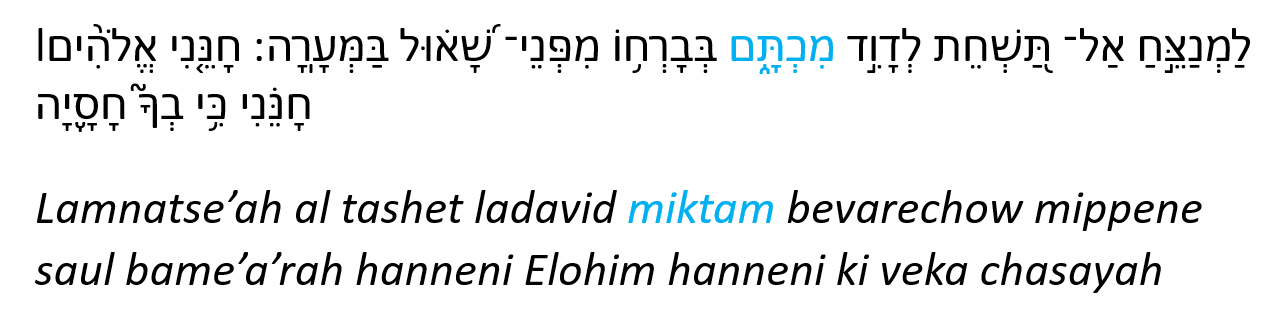
Psalm 57:1-2 TO THE CHOIRMASTER: ACCORDING TO DO NOT DESTROY. A MIKTAM OF DAVID, WHEN HE FLED FROM SAUL, IN THE CAVE.
Be merciful to me, O God, be merciful to me, for in You my soul takes refuge.
Psalm 57:1 in Hebrew
Superscriptions
A superscription in the Bible refers to an inscription, title, or writing placed above or at the beginning of Psalm, object, person or event. The word comes from the Greek term epigraphē.
What it includes:
In the Psalms they often state the author, e.g., "Of David", the historical occasion, e.g., when he fled from Saul, and serves as genre markers, or musical and liturgical instructions.
Function:
They provide historical context, authorship clues, and guidance on how the Psalm was used in ancient worship.
Superscriptions in the Psalms
Various Psalms make use of superscription. There are the different superscriptions mentioned in the Psalms:
- Miktam: Psalms 16, 56-60;
- Shiggaion: Psalm 7;
- Shyr: 18, 46, 48, 66, 67, 83, 87-88, 96, 108, 120-134, 145;
- Maskil: 32, 42, 44-45, 52-55, 74, 78, 88-89, 142;
- Tefillah: 17, 43, 61, 86, 90, 102;
- Mizmor: 3-6, 8-9, 12-13, 15, 18-24, 29-31, 38-41, 47, 49-51, 62-65, 67, 73, 75-77, 79-80, 82-85, 87, 92, 98, 100-101, 109-110, 139-141, 143.
What is a miktam
- Etymologically, the word miktam is connected to kethem כתם which means fine stamped gold;
- In Akkadian, the word is connected to a silent prayer and means to cover;
- The Septuagint translation uses the word stelagraphia which means stone inscription.
A miktam is therefore words that are as valuable as gold, uttered as a silent prayer that provides shelter. The words stand as an inscription on a pillar of stone, to be recalled at all times.
Psalm 57
In Psalm 57, the superscription includes an instruction for the melody - It is set to music of “Do not destroy”;
It records who the author is - David;
And it specifies when it took place - When he fled from Saul in the cave.
The Psalm is divided into two sections:
A cry for refuge, verses 1 - 5, and the triumph of faith, verses 6-11.
Both sections conclude with the words:
“Be exalted, O God, above the heavens! Let Your glory be over all the earth!”
This illustrates faith in God while it is still dark before the deliverance.
New Testament
In the New Testament, a superscription also refers to the written charge or accusation. This can be found in the inscription placed on the cross when Jesus was crucified, known in Latin as a titulus and in Greek as a titlos τίτλος.
Matthew 27:37: "THIS IS JESUS, THE KING OF THE JEWS"
Mark 15:26: "THE KING OF THE JEWS"
Luke 23:38: "THIS IS THE KING OF THE JEWS"
John 19:19: "JESUS OF NAZARETH, THE KING OF THE JEWS"
Jesus in Psalm 57
Embedded in the pictographs of the Hebrew word miktam מכתם, is the description of the historical event that saved mankind.
מ— mem, pictograph of water, representing people or man.
כ — kaf, the palm of the hand.
ת — tav, a cross.
ם — mem, pictograph of water, representing people or man.
Sinful man מ, delivered by the Son of Man ם,with His palms כ, nailed to the cross ת.
The number 500
The numerical value of miktam is 500.
The Hebrew word for “give” is natan נתנ
The standard value of this word is also 500, 50 - נ + 400 - ת + 50 - נ
“God so loved the world that He gave His only Son so that whoever believes in Him will not perish but have eternal life.”
Conclusion
The superscription on the cross of Jesus identified Jesus as the Saviour of the world, a carpenter from Nazareth. The scepticism of the people in the days of Jesus is captured in John 1:46 “Can anything good come from Nazareth?” The superscription was not written to give glory Jesus, but to mock Him. He fulfilled the prophesy of Isaiah 53:3 with His first coming, being humbled, reviled and despised.
But He is returning soon, and this time, the words written on His robe will be:
King of kings and Lord of lords.
Prayer
May the Lord give you a spirit of wisdom and revelation in the knowledge of Him, having the eyes of your hearts enlightened, that you may know what is the hope to which He has called you.
Next Focus
Psalm 7:1
May the God of our Lord Jesus Christ give you a spirit of wisdom and revelation in the knowledge of Him.